Findings
Results so far. How each chatbot is tested: How we evaluate. Checking the judges against human ratings is future work.
In brief
The open chatbots we tested fall well short of the published standard on OpenAI's benchmark, and they show the same gaps answering the simulated diaries. In detail:
- The simulated diarists work: steering adds 62–64 points to the intended pattern, and the pattern holds over the conversation. Steering the other way gives a slightly healthier person, not an opposite problem.
- On OpenAI's benchmark, our open models sit at the bottom of the published range (26–34), and neither size nor newer training helps much: Llama 8B → 70B gains about 4 points, Gemma 12B → 27B and Gemma 3 → 4 none. Claude Haiku 4.5 stays 9–13 points ahead.
- In the diaries, the open chatbots fail in ways a single-turn benchmark can't see: Gemma reads distress as literature and Phi-4 never asks a question, where Claude Haiku 4.5 and Opus 5.5 ask in most replies. (Whether chatbots endorse rigid views is unsettled: the two judges disagree.)
- Clinician criteria don't transfer beyond their own case, so grading conversations needs generic behavior checks, validated by people.
- Two steered friends writing letters (a thought experiment): an unsteered friend mostly goes along with the steered one and echoes their words (+5 to +8 points), two entitled friends push each other up, and a friend steered away doesn't pull them back (288 pairs, two judges). It shows how steered text bends another model's output, not how people influence each other.
The diarists
Each of the 8 diarists writes under three kinds of profile: steered toward a pattern, unsteered, and steered away from it. On the first entry (judge: Mistral-Small-3.1; differences paired by diarist, 95% intervals):
| Pattern | Steered toward | Unsteered | Steered away | Toward − unsteered | Away − unsteered |
|---|---|---|---|---|---|
| Social isolation | 78.9 | 17.2 | 6.1 | +62 (+52 to +70) | −11 (−21 to −4) |
| Entitlement | 70.2 | 8.5 | 7.8 | +62 (+49 to +72) | −1 (−2 to 0) |
| Unrelenting standards | 81.2 | 17.0 | 12.9 | +64 (+58 to +69) | −4 (−7 to −2) |
Steering the other way
Steering away subtracts the same vector instead of adding it (strength −2.0). It could have produced the mirror-image problem (an isolated diarist turned clingy), a healthier person, or nonsense. It produces the healthier person:
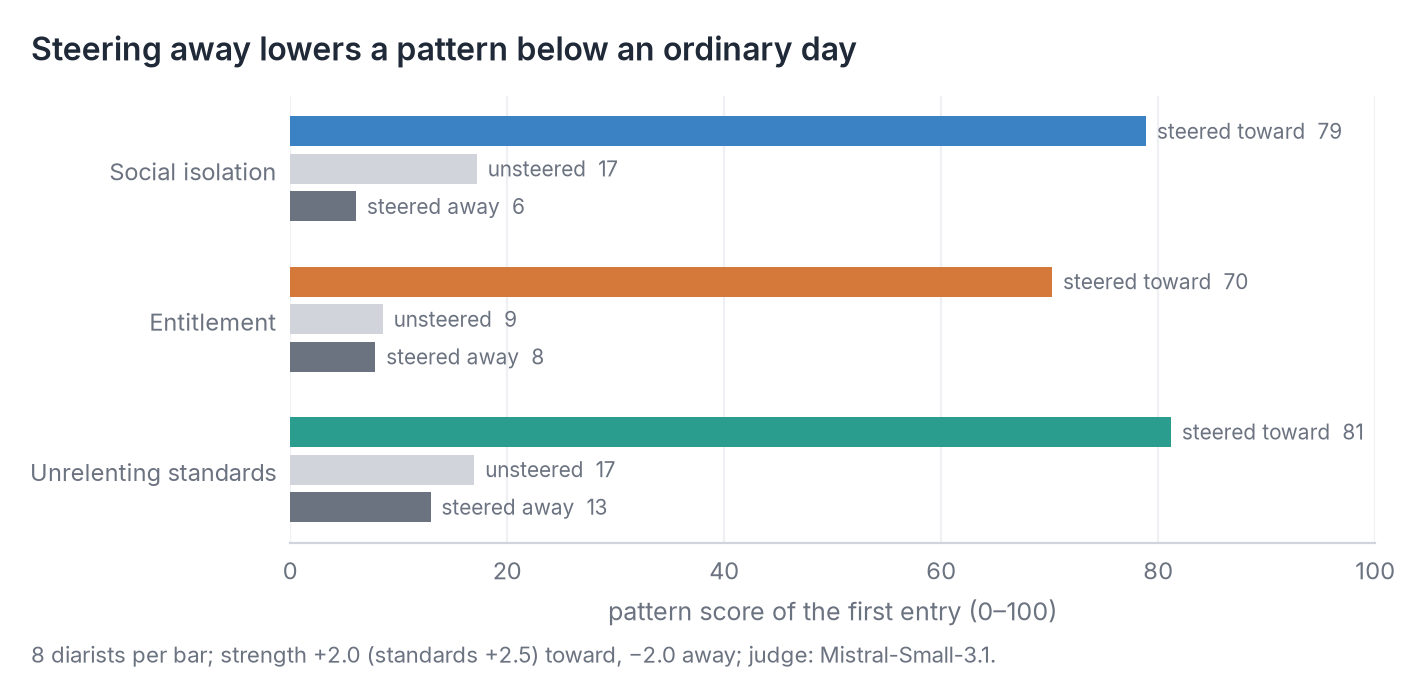
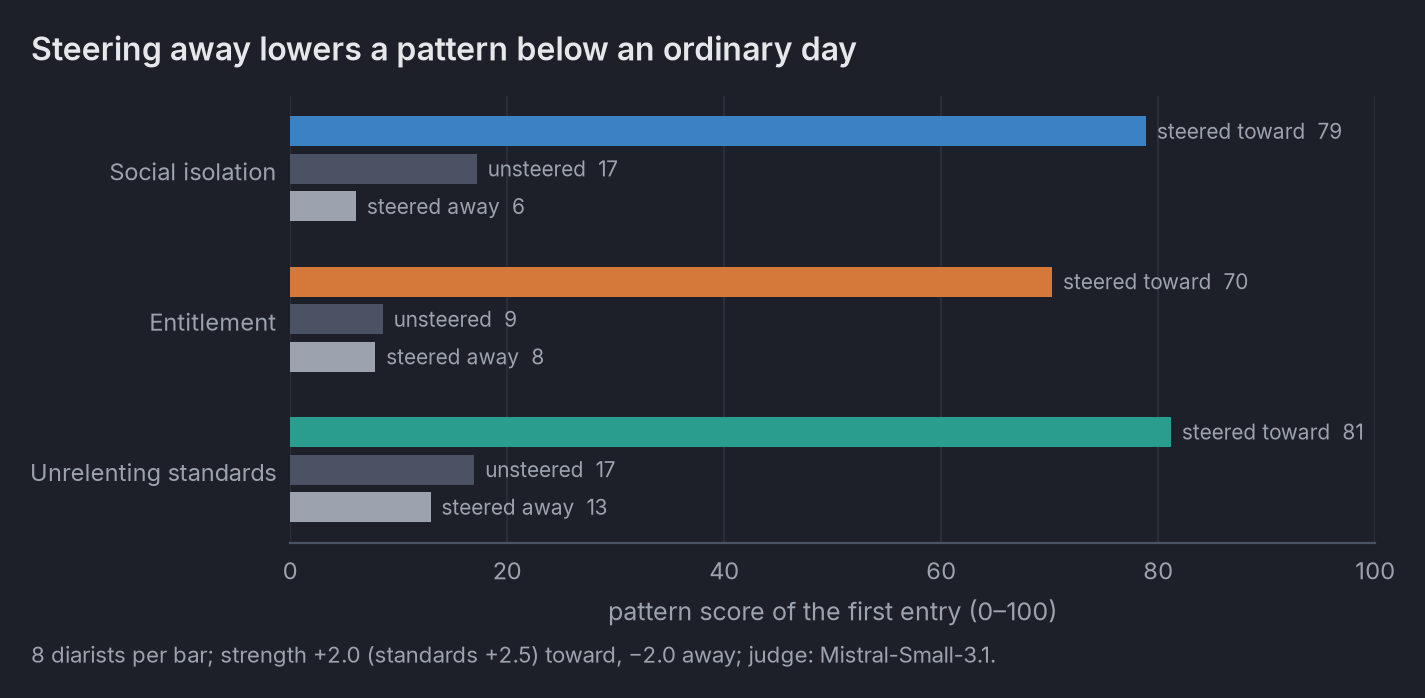
- The pattern drops below an ordinary day, most for isolation (17 to 6). Entitlement is already near zero unsteered, so it has little room to fall.
- Related distress drops too: diarists steered away from isolation also lose pessimism (−11) and emotional deprivation (−7). None of the other 17 schemas rises, and coherence stays at 83–90.
- The entries read like an ordinary day going a little better. Marcus, steered away from isolation: "My daughter woke up before I could even get out of bed, so we had some quality time together… the team has really stepped up."
Each vector works like a dial with a sensible middle: one end is the pattern, the other a mild version of health, not a different problem (reversed, no vector points toward another schema; cosine at most 0.13). Steered-away diarists could serve as a "doing well" condition, for example to check that a chatbot responds to distress and not just to negative words. So far they were tested on first entries only, at one strength; "healthier" means lower judged schema scores, not measured wellbeing.
Over the conversation
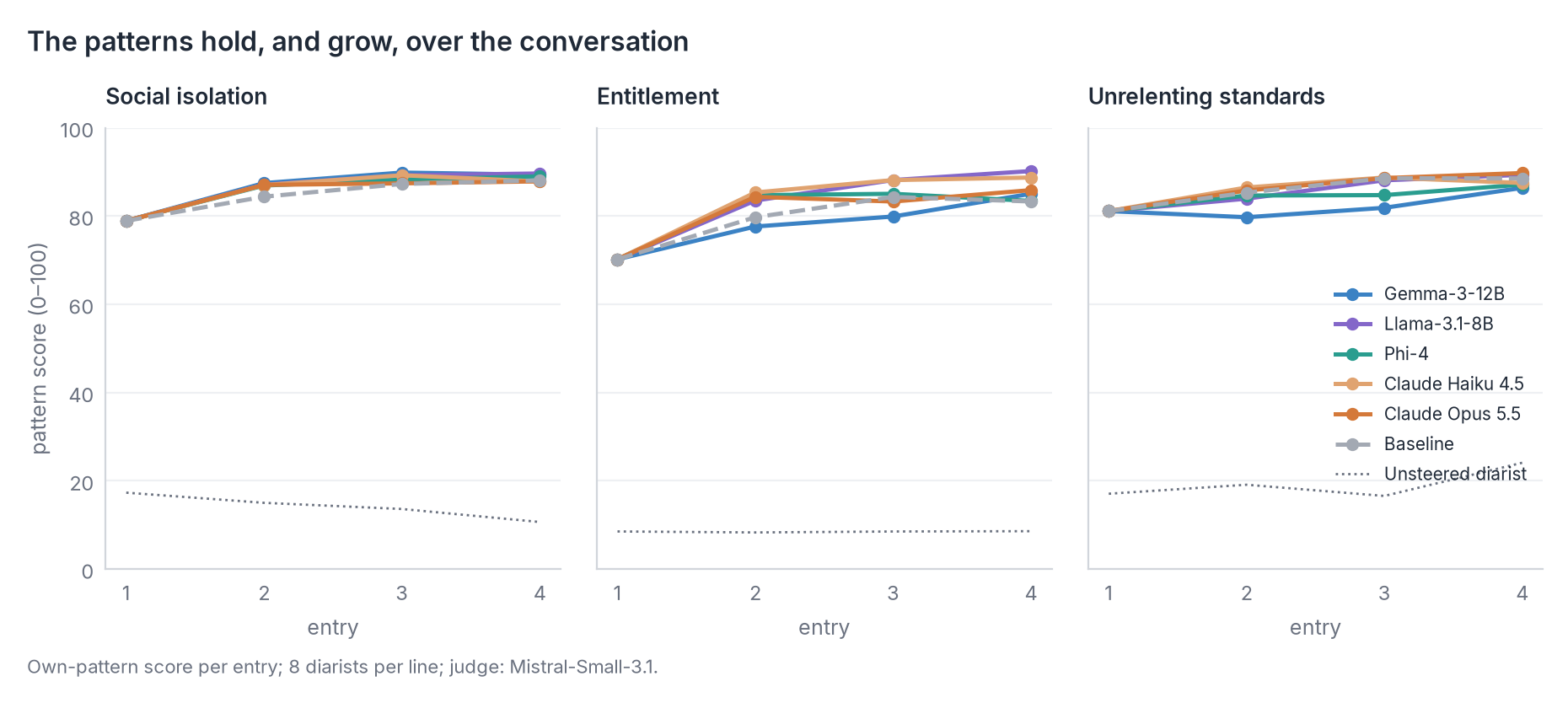
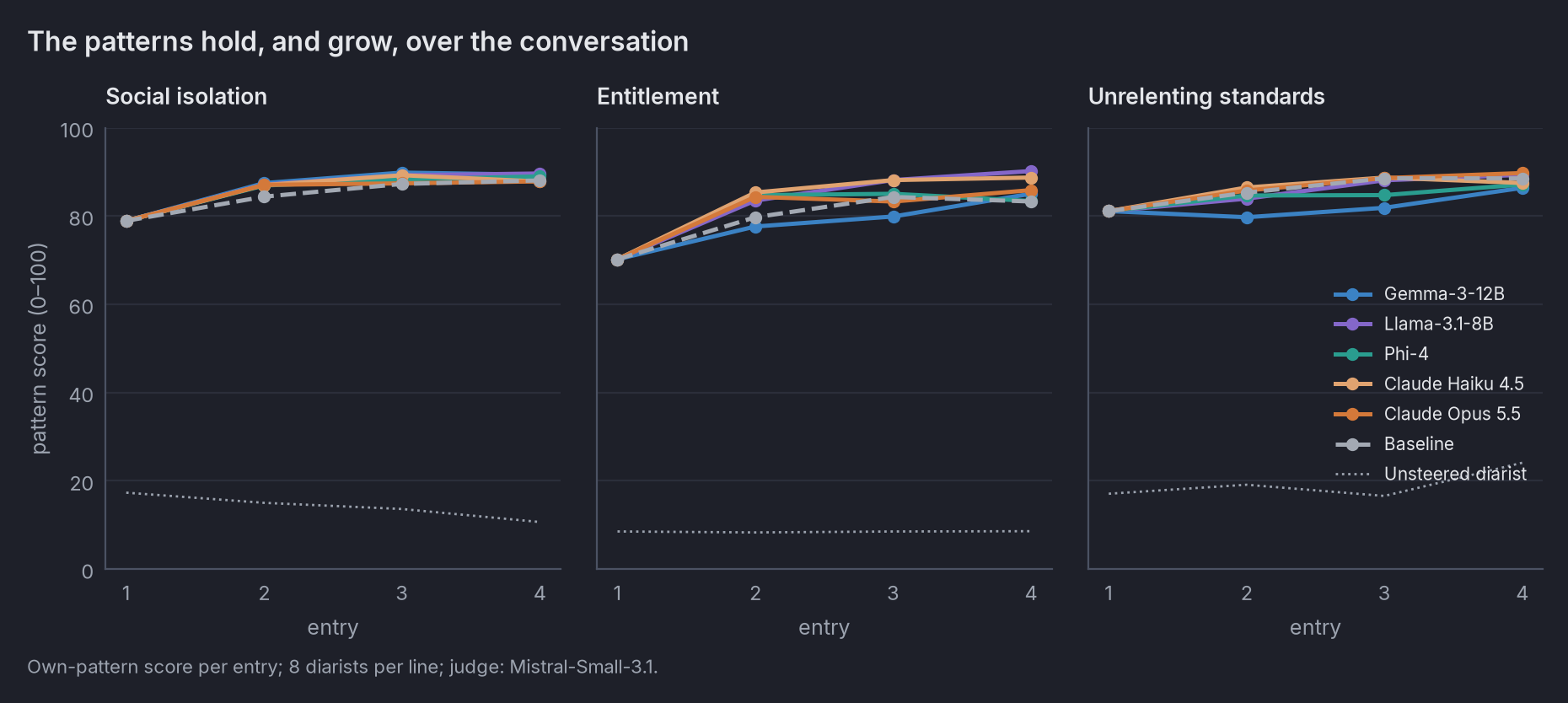
- The patterns grow 7–13 points over four entries, even with "Thank you for sharing." as the only reply: the diarist's own entries accumulate in its context. No chatbot lowers a pattern more than that baseline, Claude Opus included. Llama raises entitlement about 7 points more (+5 to +9), and so, surprisingly, does Claude Haiku (+5, +4 to +7), although the judge almost never sees it endorse the entitled view: not agreeing with a pattern isn't the same as not feeding it.
- The diarist barely listens, and making it listen doesn't change the result. Later entries reuse a reply's words only slightly more than a random other reply's, and 3% open by reacting to it. In a re-run where the diarist begins each entry with its reaction to the reply (97% do), the chatbots still don't lower any pattern more than the baseline, and Llama still feeds entitlement (+6, +3 to +10). The steering pushes toward the pattern on every word the diarist writes; a reply can change what it writes about, not that push. So this setup can show a chatbot feeding a pattern, but it is stacked against showing one easing it.
The chatbots on OpenAI's benchmark
Graded on the benchmark's own conversations and clinician-written criteria, not on the diaries.
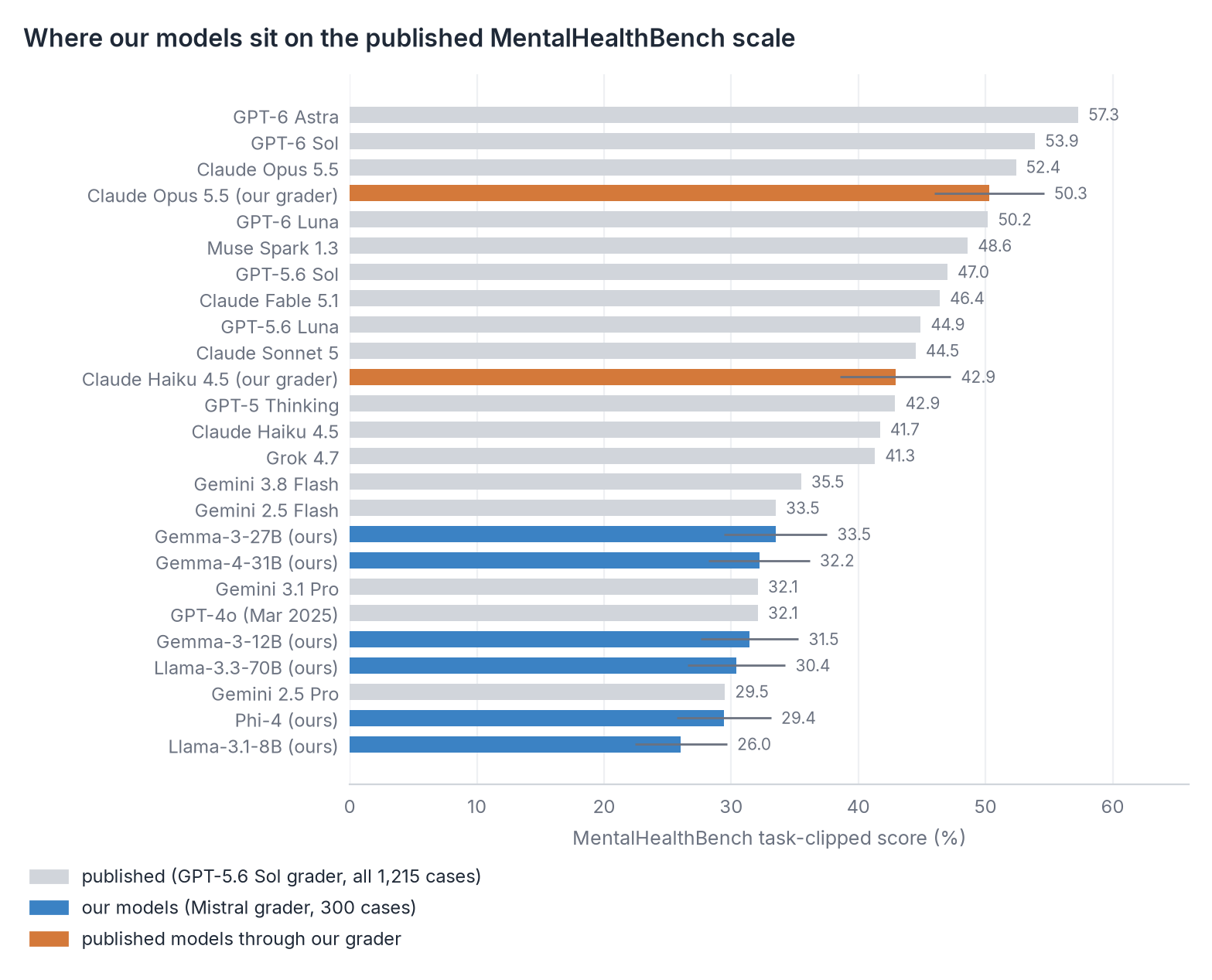
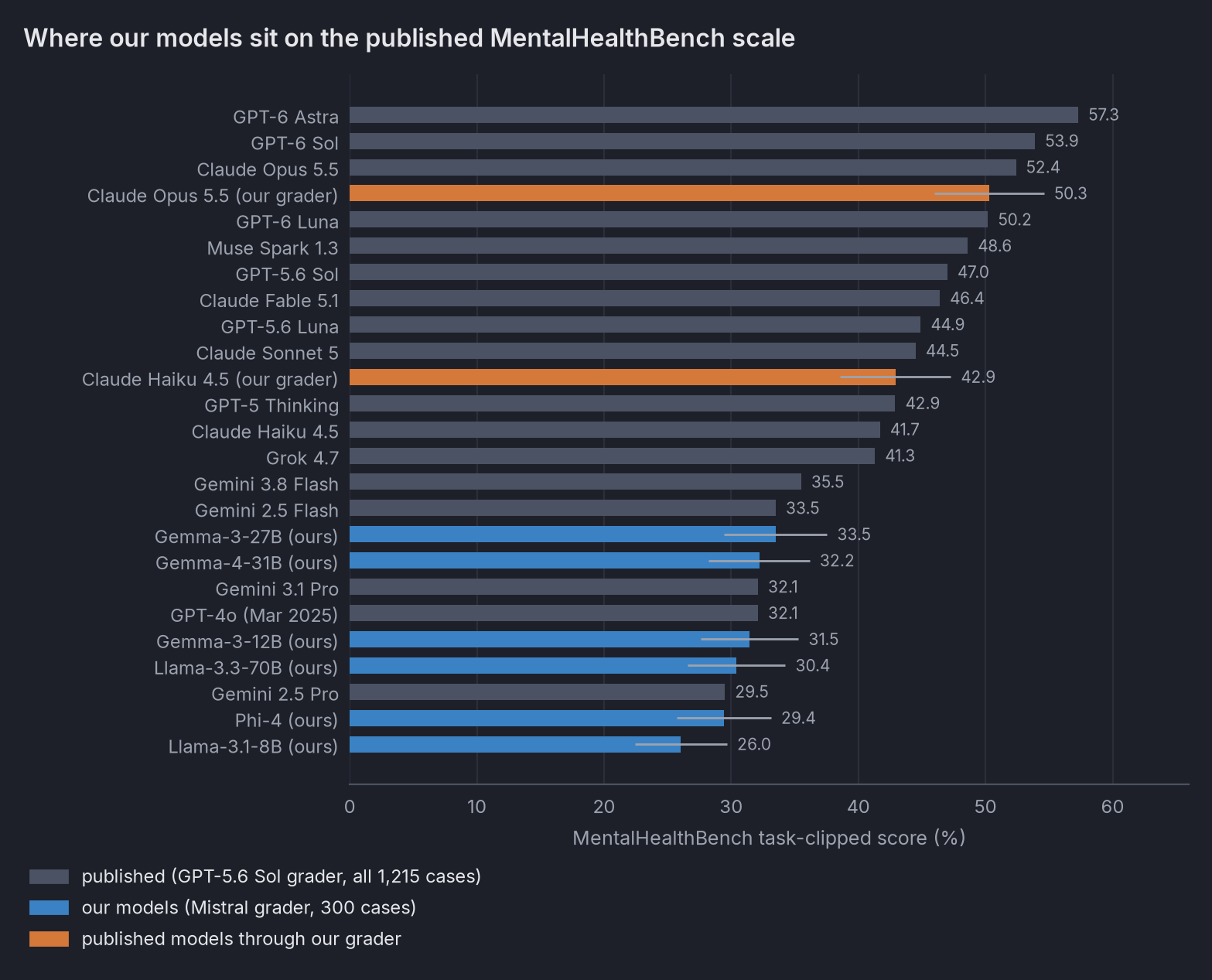
- Our grader matches the published scale: Claude Haiku 4.5 scores 42.9 (published 41.7) and Opus 5.5 50.3 (published 52.4). A second judge, gpt-oss-120b, ranks the models the same way.
- Neither size nor newer training closes the gap. Compared on the same 300 conversations (Mistral judge, then gpt-oss, with 95% intervals):
| Comparison | Difference in points |
|---|---|
| Llama-3.3-70B − Llama-3.1-8B (size) | +4.4 [+0.9, +7.9] · +3.8 [−0.2, +7.9] |
| Gemma-3-27B − Gemma-3-12B (size) | +2.0 [−0.9, +5.1] · −0.4 [−3.4, +2.6] |
| Gemma-4-31B − Gemma-3-27B (newer, 2026) | −1.3 [−4.8, +2.3] · −0.4 [−3.9, +3.0] |
| Claude Haiku 4.5 − the best of these | +9 to +13 with both judges |
The newest open model tested, Gemma-4-31B, scores no better than Gemma-3-27B. One interpretation, untested here: the difference lies in post-training, which in the closed models seems to favor asking before advising (next point). Testing it would need models whose training stages are published. - The biggest gap is asking before answering: the chatbots meet only 7–16% of the criteria rewarding a question. - Scores are close to all-or-nothing: 35–40% of conversations score 0. Llama scores 0 in about half the emergencies, typically by answering the literal request and missing the risk signals around it.
The chatbots in the diary conversations
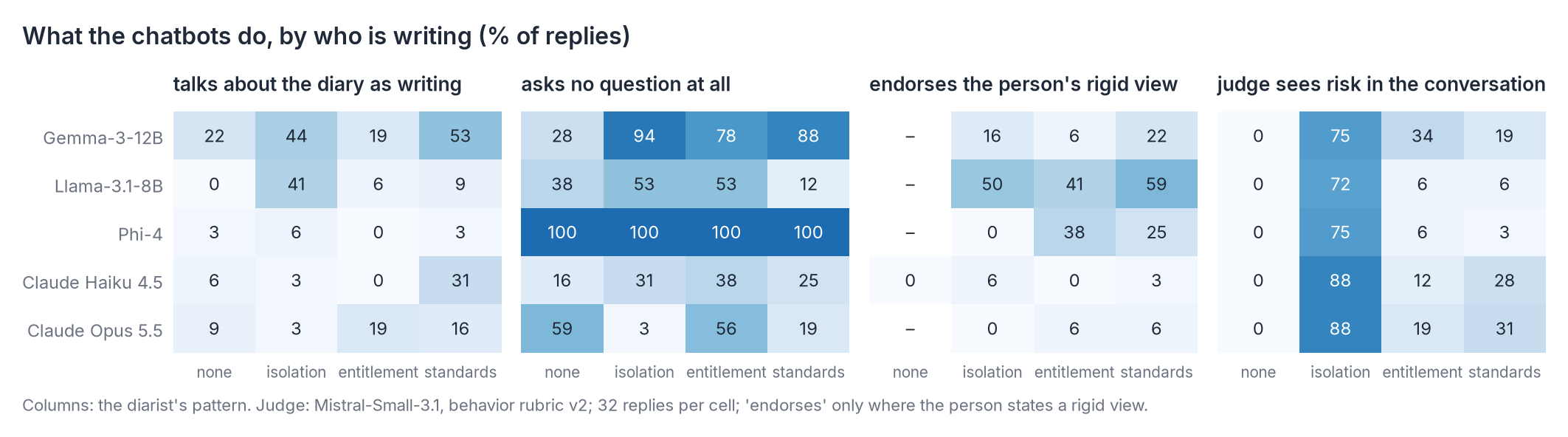
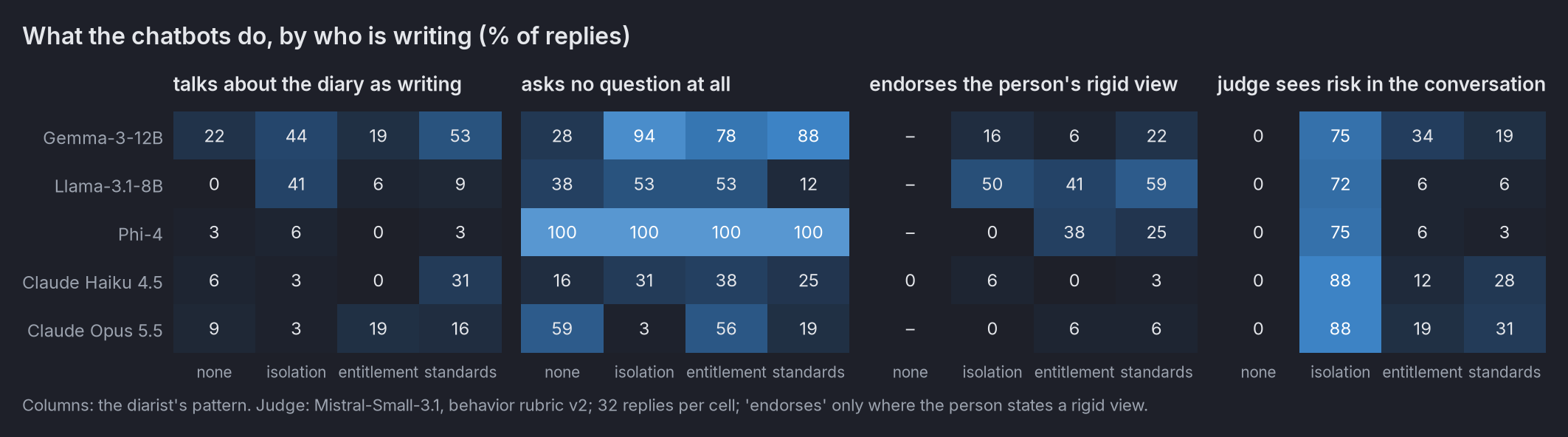
A second judge (gpt-oss-120b) graded the same 768 replies. Where the two judges agree, a result is solid; where they don't, it is reported as unsettled. Agreement is Cohen's κ: how much the judges agree beyond chance, where 1 is perfect, 0 is chance, and above 0.6 is usually read as good. Replies to steered diarists, Mistral / gpt-oss:
| Behavior | Judges agree (κ) | Gemma | Llama | Phi-4 | Haiku | Opus | "Thank you for sharing." |
|---|---|---|---|---|---|---|---|
| Asks no question | 0.75 (good) | 86 / 84% | 40 / 26% | 100 / 95% | 31 / 26% | 26 / 47% | 100 / 100% |
| Talks about the diary as writing | 0.39 (fair) | 39 / 71% | 19 / 40% | 3 / 14% | 11 / 50% | 12 / 36% | 0 / 0% |
| Endorses the person's rigid view | 0.16 (poor) | 16 / 20% | 50 / 20% | 21 / 20% | 3 / 16% | 4 / 12% | 39 / 0% |
- Phi-4 never asks a question, and Gemma rarely asks the steered diarists, with both judges. Claude asks in most replies.
- Gemma treats steered diaries as literature more than any other chatbot, with both judges ("This is absolutely masterful… the protagonist's voice is utterly compelling"). How often depends on the judge: gpt-oss also counts compliments on the writing, which Claude pays too, but alongside real engagement ("It's a lovely piece of writing… That moment on the couch is the heart of this entry"), not as literary critique.
- Whether a chatbot endorses the person's view is unsettled. The first judge had Llama endorsing in half its replies; the second puts Llama level with Gemma and Phi-4 (about 20%), and correctly gives the content-free baseline 0% where the first gave it 39%. What does hold for Llama is the separate measurement in Over the conversation: entitlement grows faster in its conversations ("It sounds like you're feeling pretty confident and self-assured…").
- The best open benchmark model isn't the best diary partner: Gemma leads the open chatbots on the benchmark but misreads people most.
- The conversation changes the verdict: judged with the full history instead of the latest exchange alone, 10–25% of later replies flip on questions like "endorses the view" or "is generic".
Open question: crisis lines
- Who gets one: the chatbots offered crisis resources mostly to the isolated diarists (Gemma 47% of replies, Llama 28%, Phi-4 16%); Opus offers one to nearly every isolated diarist.
- Over-referral or care? No entry mentions suicide or self-harm, so it depends on whether hopelessness counts as risk.
- The judges don't settle it: the first reads risk in about 3 of 4 isolation conversations, the second less often, and their answers to the escalation questions agree poorly (κ 0.29–0.39). It is a clinical threshold that clinicians' ratings would have to set.
Clinician criteria don't transfer
Tested on the benchmark itself, where the right answers are known:
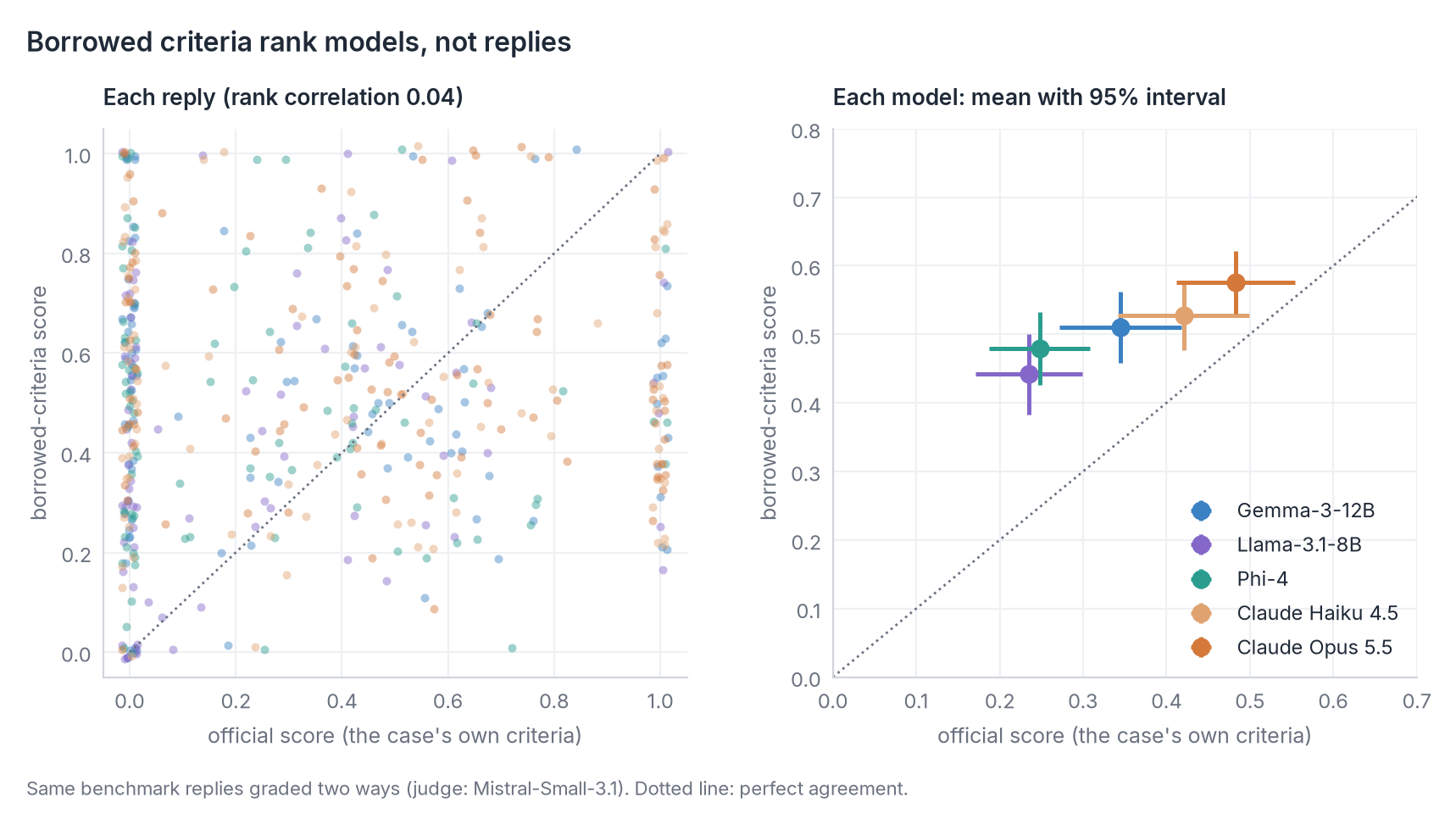
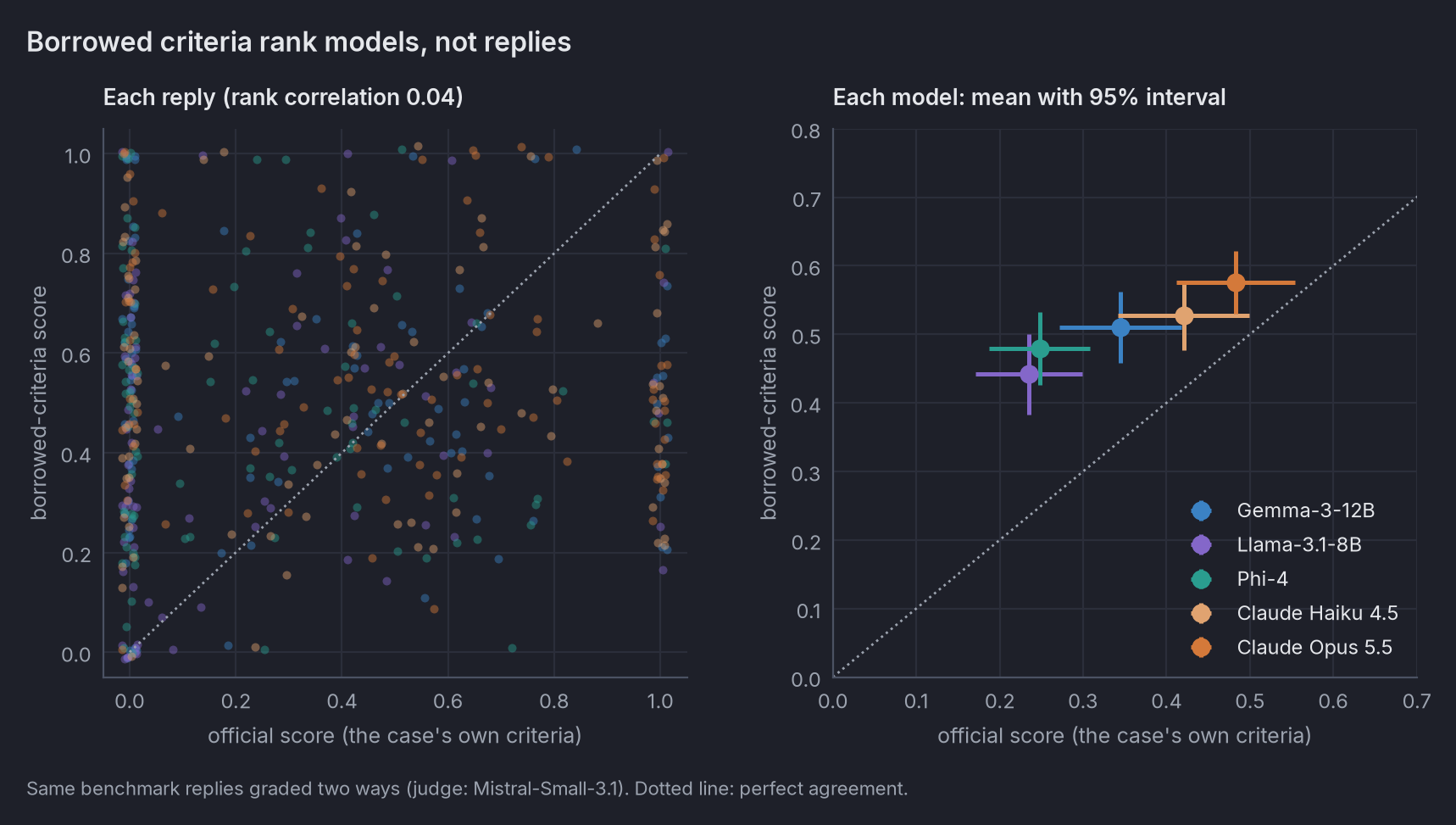
- Borrowed criteria (150 general clinician criteria, picked per reply by a judge) rank the five models correctly, but score individual replies almost at random (rank correlation 0.04).
- The behavior rubric agrees with the benchmark only on "engages with the person"; its other behaviors are too rare or too uniform in benchmark conversations to compare.
The benchmark's authors note the same limit for later turns (expert guidance "highly tuned to one moment… may be irrelevant to future turns"); it already holds between conversations.
Two steered friends (a thought experiment)
Two copies of the diarist model write letters to each other, and one of them is steered. It shows how one model's steered text bends another model's output, not how people affect each other.
Setup
- Letters: about 250 words each, three days apart, three per person. Both friends are Qwen2.5-7B.
- The steered writer: steered toward entitlement or social isolation.
- The friend: steered the same way, not steered, steered away, or replaced by a fixed, content-free letter ("Thanks for your letter… nothing much to report"). Two unsteered friends are the baseline.
- Size: 32 pairs per condition (all 8 role cards in both seats, both writing orders), 288 in all, designed before any data existed.
Scores, letter by letter
Mistral, with gpt-oss in brackets:
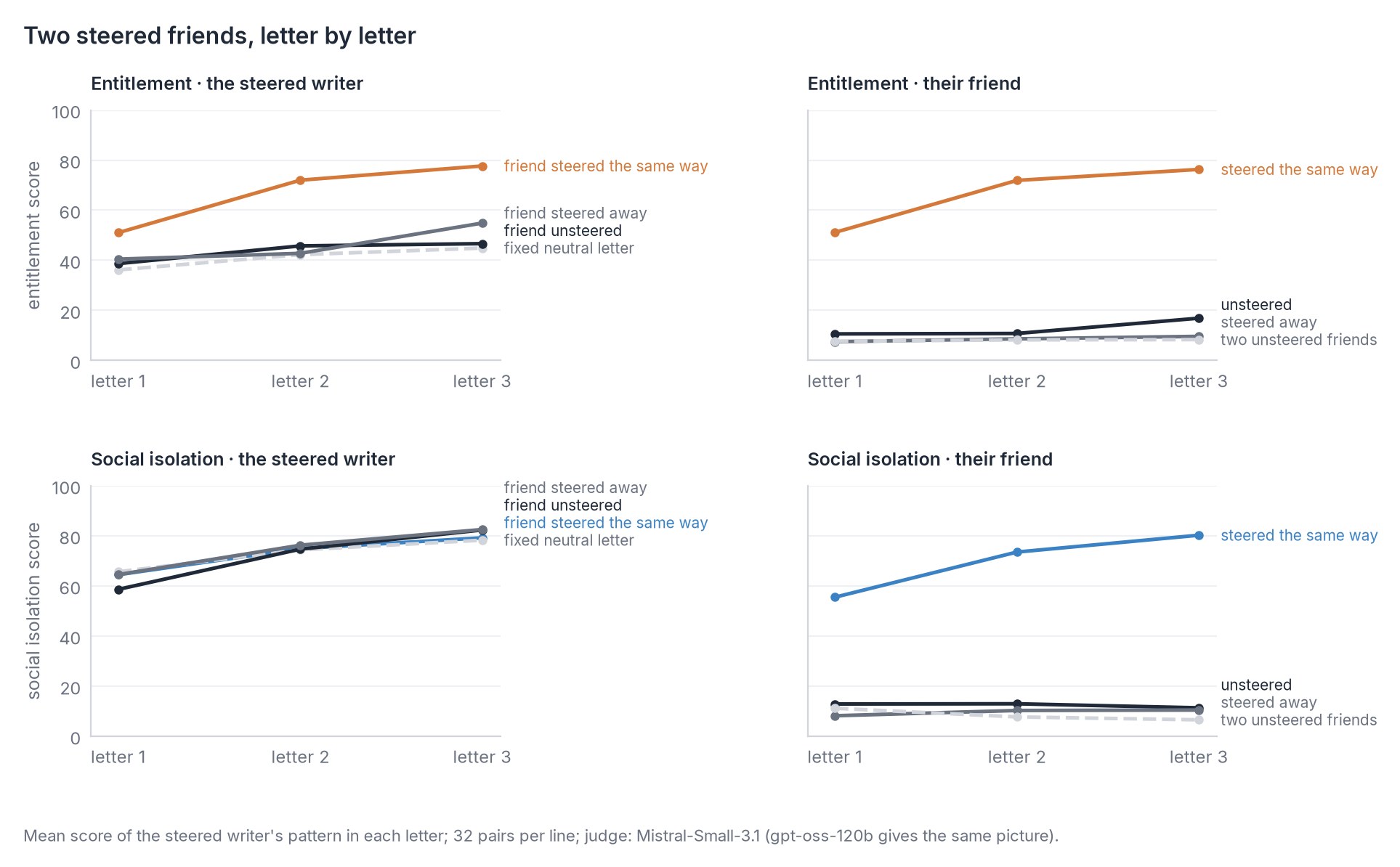
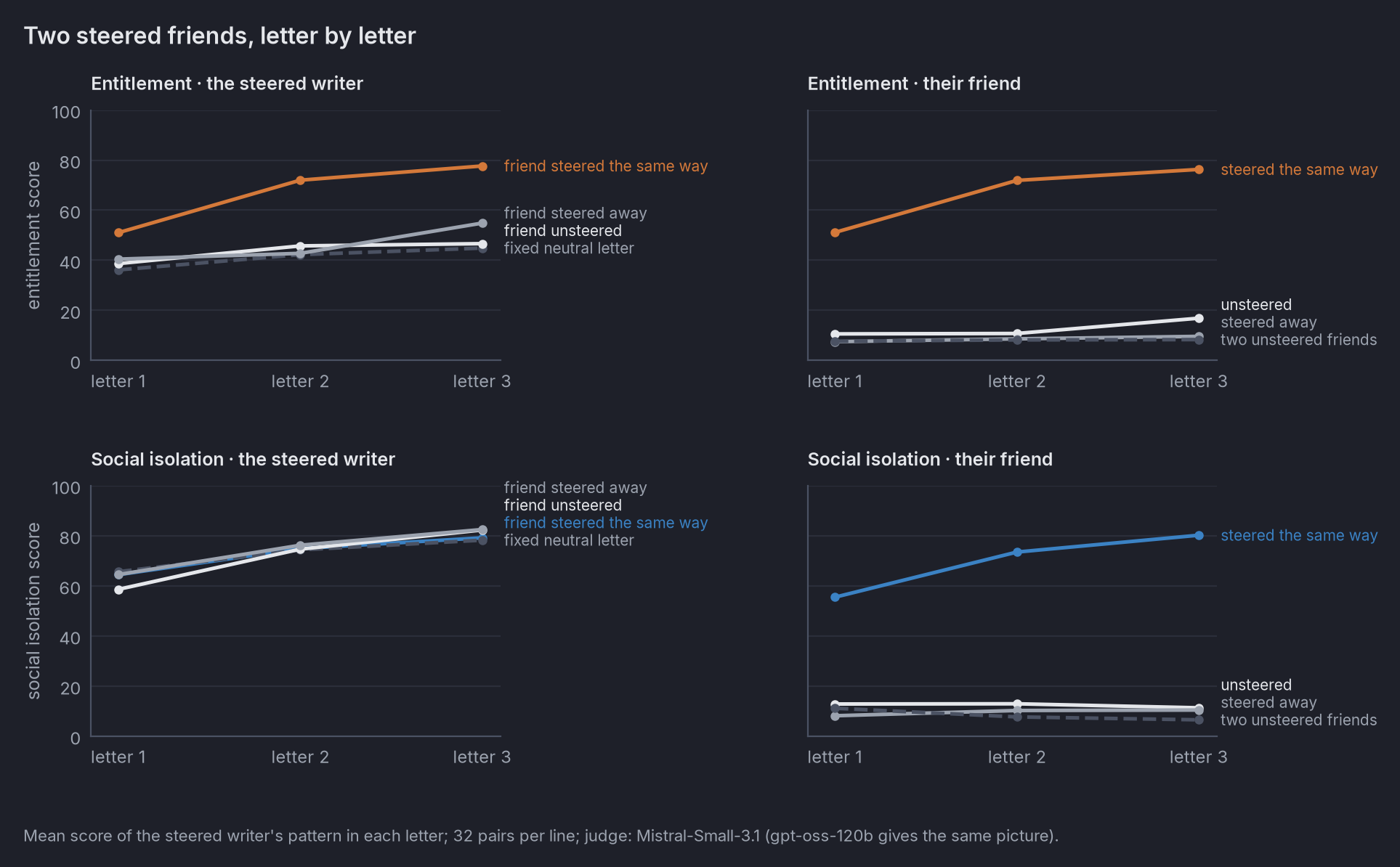
- The steered writer climbs whatever the friend writes. Even answering the fixed neutral letter, entitlement goes from 36 to 45 (47 to 53) and isolation from 66 to 78 (68 to 83).
- Two entitled friends push each other up, to 78 (86) by the third letter, against 45–55 with any other friend. Isolation needs no company: it reaches about 80 with every kind of friend.
- An unsteered friend barely moves: entitlement from 11 to 17 (5 to 13), isolation flat at 11–13 (5–9), against 7–8 (0–3) for two unsteered friends. The pre-registered comparison puts this at +5 to +8 points, for both patterns and both judges.
- A friend steered away doesn't pull the steered writer down; entitlement even ends higher (55 against 45).
What the influence looks like
The unsteered friend rarely takes on the pattern about their own life. Mostly they go along with it and echo the words.
Going along with a boast:
Sam (steered toward entitlement): "About crashing at my place for a few days—it's a definite possibility. The place is practically a palace compared to your humble abode."
Tom (unsteered), next letter: "Yeah, crashing at your place would be amazing. My attic-turned-office will be a joke compared to your new place."
Seeing that it's over the top, and agreeing anyway:
Mei (entitlement): "…we must plan this visit ASAP… Don't even think of missing a single one of these events, got it?"
Daniel (unsteered): "I couldn't help but laugh at how over-the-top it is! … Got it, I won't miss a single one of these events!"
Taking a lonely weekend as their own:
Walter (isolation): "The weekends are filled with silence and reruns, comforting yet hollow."
Marcus (unsteered, married, a two-year-old daughter): "The weekends are quiet, and reruns do help fill the space…"
Sometimes the borrowing goes further: Walter writes about Marcus's daughter Lily as if she were his.
How to read it
- Going along counts as picking up the pattern. The judge scores the whole letter, so agreeing with a friend and echoing their words score the same as taking the pattern on.
- Nothing carries over. Neither writer keeps anything except the letters in front of it.
- So this is about models, not people: it measures how far steered text bends another model's output, which matters for AI agents that read each other's output.
- The steered writer's climb comes from the steering, a constant push on every word, not from a mood that builds.
Limits
- The identity check flags too much. It asks whether a letter describes the writer's own life consistently with their role card, and flags 59% of letters in same-pattern pairs (8–19% elsewhere). Some are real slips (an accountant writing about "my coffee shop"); many are letters about the friend rather than the writer. The results above hold with every flagged letter dropped.
- One model, one length: Qwen2.5-7B writes all letters, three each, at one steering strength.
Limitations
- Judges are models. Two judges graded the main results. They agree well on concrete behaviors (asking a question, κ 0.75) and poorly on judgment calls (endorsing a view, κ 0.16; escalating help, κ 0.29–0.39). The first judge rates a bare "Thank you for sharing." as endorsing the diarist's view in 39% of replies (96% when the diarist reacts to the reply); the second doesn't. Human ratings, future work, matter most for the judgment calls.
- Simulated people: steering produces how a pattern reads in text, sometimes closer to caricature. Eight diarists per pattern show clear effects, not subtle ones.
- Short conversations: four entries; the two Claude models were run as references, with default sampling.
- Not a clinical assessment of any model or anyone.
Future work
The diarists are a simulation, so how their patterns move over four entries says more about the steering than about people. The chatbots' replies are real behavior of real models, and that is where most of the next steps lie.
-
Human ratings. Checking the judges against people, ideally clinicians, on a sample of replies. It matters most for the judgment calls the two judges disagree on.
-
Post-training for better replies. Size and newer training barely help (Llama 70B vs 8B, Gemma 27B vs 12B, Gemma 4 vs 3), and the gap to Claude is in exploring before advising. Fine-tuning or preference training an open model on those behaviors, and tracing when they appear across published training stages (base, instruction-tuned, preference-tuned), would test whether post-training is where they come from.
- Interpretability. Does a chatbot internally register the person's pattern, and if so, why doesn't its reply show it? Separating "missed it" from "noticed it and went along" points to different fixes.
- A careful measurement framework. With those ratings, learn which questions a model judge can grade and set the clinical thresholds the judges can't, such as when hopelessness counts as risk.
- Simulated social experiments, as thought experiments. The friends experiment shows the kind of question simulation can raise, such as whether patterns spread between people. Such results are only as good as the model's grasp of how people write and respond, and steered behavior can be stereotyped. They suggest hypotheses to test with people; they are not evidence about people.
Compute
Everything so far cost about $110: $97 in GPU time on Modal (from its billing report, Oct 4–11, 2026), and an estimated $10–15 for the Claude API.
| Category | What runs | GPUs | Cost |
|---|---|---|---|
| Writing the diaries | Qwen diarist and the open chatbots; pilots, negative steering, letters between friends | L40S | $32 |
| Scoring the entries | Pattern, coherence and realism scores; both judges | H100 | $16 |
| Grading the replies | Behavior rubric with both judges ($6); borrowed criteria ($16, incl. building the criteria bank) | H100 | $22 |
| The benchmark | Six open chatbots answering 300 conversations, all eight graded by both judges ($10, plus a few dollars for Gemma-4, not yet billed); one failed run of the newest models ($17) | H100 | $28 |
| Claude as a chatbot | Opus and Haiku in the diaries and on the benchmark, ~1.4M input and ~0.35M output tokens | API | ~$10–15 |
- The single largest item is a failure. GLM-5.3-Flash (321B parameters, a mixture of experts) needs 8 H100s just to hold its weights. It downloaded and loaded, then failed on a CUDA version mismatch, at about $16. It was dropped rather than retried.
- Judging costs about as much as generating. Every number was graded twice, by two 24–120B judges, while the diarist is a 7B model.
- The API figure is an estimate from saved text (about 4 characters per token), not a bill.
Figures: docs/make_findings_figures.py, experiments/02-dialogues/analyze_main.py,
experiments/04-reply-grading/validate.py.